
TRELLIS
SLEEPING GIANT
BIGMANARTS @ DTW
JUL. CAESAR SUPERSTAR
BROADS/RELATIVES
BARRY GOLDHUBRIS
THE BACON SHOW
GOLDHUBER & LATSKY
BILL T. JONES/ARNIE ZANE DANCE COMPANY
OTHER PICS
BIOGRAPHIES
PRESS


"extremely hefty" Artforum

"unapologetically bulky" LA Times

"chubby but dainty" Oakland Tribune

"not a small man" The New York Times

"extremely corpulent"
San Francisco Examiner

"tubby... mountainous... heroic" Village Voice

"a gentleman of Falstaffian proportions" Bergen Record

"fills a room just by showing up" New York Magazine

"a distinctly portly fellow" The New Yorker

"an actor-dancer-choreographer of impressive avoirdupois" The Village Voice

"An artist of considerable depth and refinement"
"First-rate theater with a surprising edge of poignancy."
Jennifer Dunning, The New York Times

"a witty, touching dance-maker"
Roslyn Sulcas, The New York Times

"Goldhuber is an ingenous theatrical director"
Lisa Jo Sagolla, Backstage

"Goldhuber is nothing short of a miracle...light and playful as a gazelle."
Lynn Garafola, Dance Magazine

"Commands respect and affection from his very first move...astonishingly agile
and swift as well as immensely perceptive and confident..."
Tobi Tobias, New York Magazine

"Made the audience laugh outloud...elegant, stylized, and comical."
Sarah Wallis, Lillith Magazine

"Fierce attention to every step and gesture brought the house down."
Elizabeth Zimmer, The Village Voice


LAWRENCE GOLDHUBER KICKS NARCISSISM UP A NOTCH 

By Laura Shapiro

We may be having a cold winter, but with so much political hot air swirling around, it’s as if the whole nation were trapped under some vast, puffy quilt stuffed with rhetoric. The piety and patriotism, the hands on the heart, the earnest analyses and reassessments and scrutinizing of campaign declarations so vacuous they defy the laws of chemistry—thank goodness all this stuff provides one useful service, namely supplying a perfect context for Lawrence Goldhuber’s new theater piece at P.S. 122.

Everything about The Life and Times of Barry Goldhubris is oversize except the work itself, which is quite concise: It runs less than an hour and has a cast of one. But that one is Goldhuber, and the guy fills a room just by showing up. For years he was an enormous, unforgettable presence in the Bill T. Jones/Arnie Zane Dance Company; more recently he’s been choreographing and performing on his own.

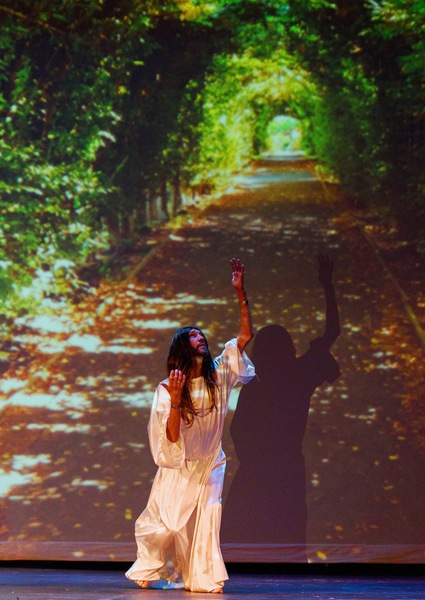
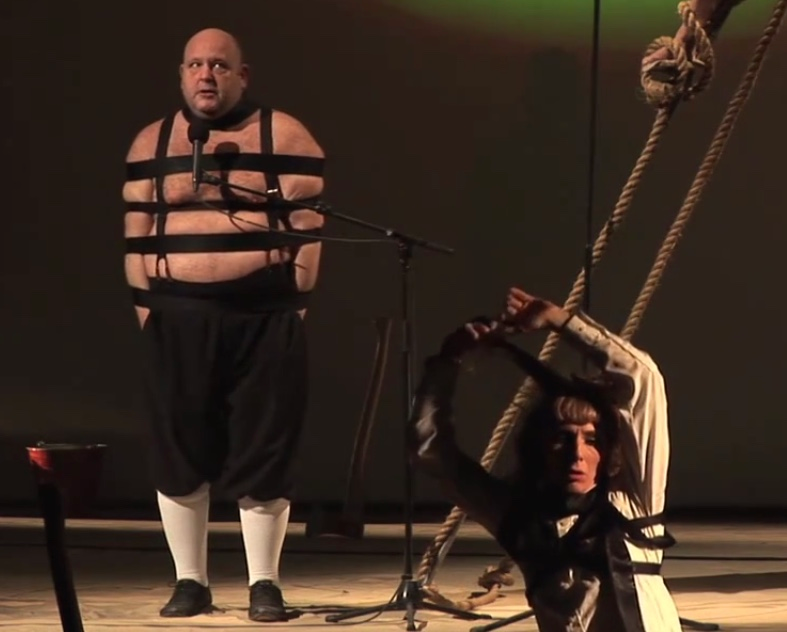
Life and Times, written and directed by Goldhuber and David Brooks, is a kind of biopic in which he plays America itself. Framed by video footage on three screens, Goldhuber contains multitudes. First he personifies a mythological birth, diving into the world as the heavens shake; then he’s the star in a living-my-dream success story; and when that story ends in a locked ward, he becomes all the demons racketing through his own brain. Huge video images of his face assail him as he rolls on the floor in a straitjacket shouting, "Why does everything happen to me, me, me?"

That cry—Me, me, me—may be the most nakedly American moment in the piece. There are plenty of cultural references here, from the highway footage onscreen to Goldhuber’s desperate mumble, "Be all you can be I can’t believe it’s not butter it’s the real thing where’s the beef?" But more telling than any of these is simply Goldhuber, embodying a narcissism as big as the world. In a final, raging dance, he struggles to get his giant self out of that straitjacket, then bursts free singing "Only in America." It’s as scary as the nightly news.


'When the World Smells Like Bacon': A Tasty B.L.T for a Meditator Writ Large

By JENNIFER DUNNING

Lawrence Goldhuber called his evening of dance "When the World Smells Like Bacon." He also made and began to eat a bacon, lettuce and tomato sandwich on the stage in the title piece, a meditation on families, Judaism and being fat, in a program presented on Sunday night at P.S. 122.

Mr. Goldhuber, a former Bill T. Jones dancer famous for his 350-pound weight, turns such everyday topics into charmingly unassuming, first-rate theater with a surprising edge of poignancy.

The centerpiece of the program was the new "Dances With Wolves," created and performed with Keely Garfield. The two make an enjoyably sly pair of combative, nutty lovers as they glide about the floor to old and new popular favorites. It is fun to see them doing a "Fred and Ginger" every now and then in a score that includes Astaire singing "Let's Face the Music and Dance."

But even better is their comic timing and Mr. Goldhuber's small, oddly telling gestures, as when he appears to write disconsolately across the bottom of Ms. Garfield's sequined gown.

Gisela Stromeyer's simple set creates an elegant ballroom, with the bright colors of Robert Wierzel's lighting bouncing off curved fabric pillars.

Mr. Goldhuber is good at evoking large worlds in small solos. King Kong and the sadness of unlikely yearning come touchingly alive in "Love Defined." Mr. Goldhuber's guitar-playing old woman in "Soy (I Am)" suggests a range of emotions and also, cleverly, of early modern-dance images.

Mr. Goldhuber plays the bemused referee of a sensual boxing match in Nuria Olive-Belles's stylish film, "The Fight," and makes nuzzling love to Heidi Latsky with his head in Gretchen Bender's stylized "Head Duet," also a film.   February 9, 2001


PORTRAIT BY DANIEL DUFORD


Review No. 25
Posted: May 16, 2005
Lawrence Goldhuber/BIGMANARTS
Danspace Project
May 13, 2005

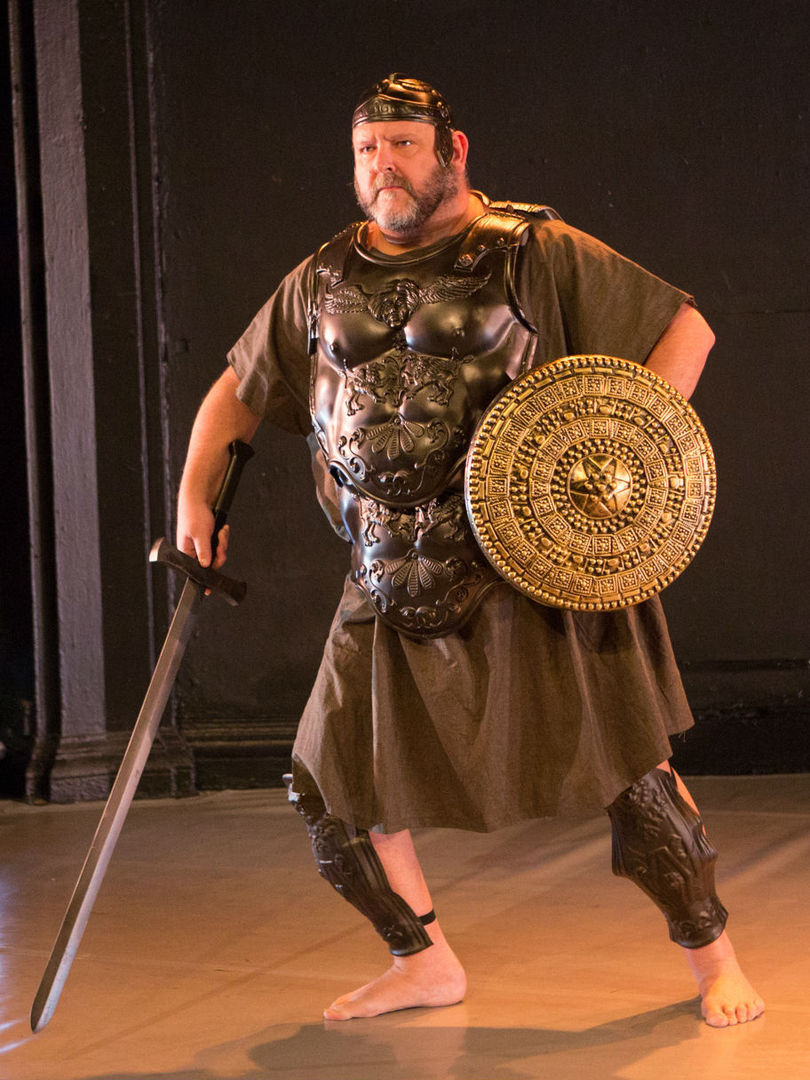
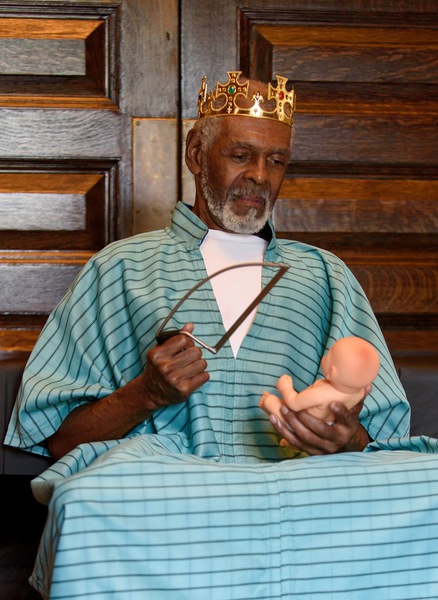
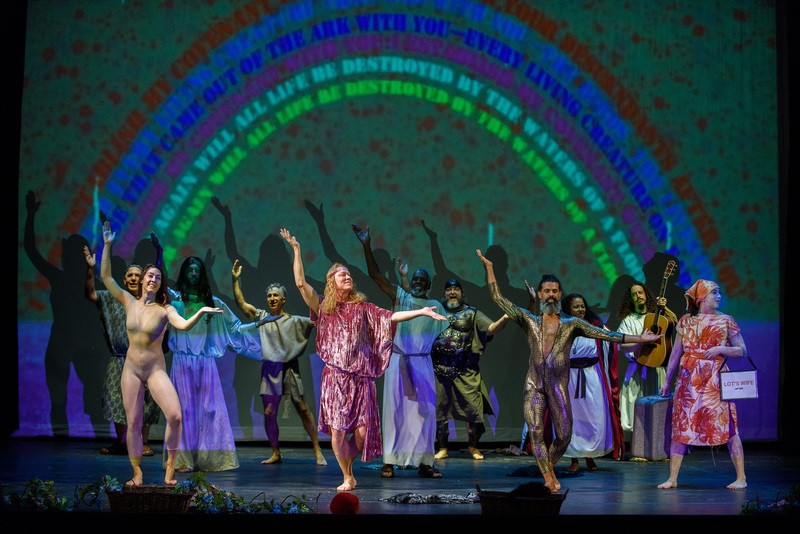
Exhilarating! Lawrence Goldhuber's new dance drama, Julius Caesar Superstar, does everything on a grand scale. Sure the piece has a cast of heavyweights playing Roman senators who, like the famously portly Goldhuber, carry considerable heft either through natural endowment or fat-suit enhancement, but that's not what I'm talking about.

By "everything" I mean choreography, musical score, video, lighting, and costumes-all contributing generously to a great, sweeping work that comes on like a vest-pocket Broadway smash, all packed into the space of an hour. The production moves swifter than you might expect and never flags-just like Goldhuber and his senatorial co-conspirators. Even its excesses seem purposeful. That's some kind of magic!

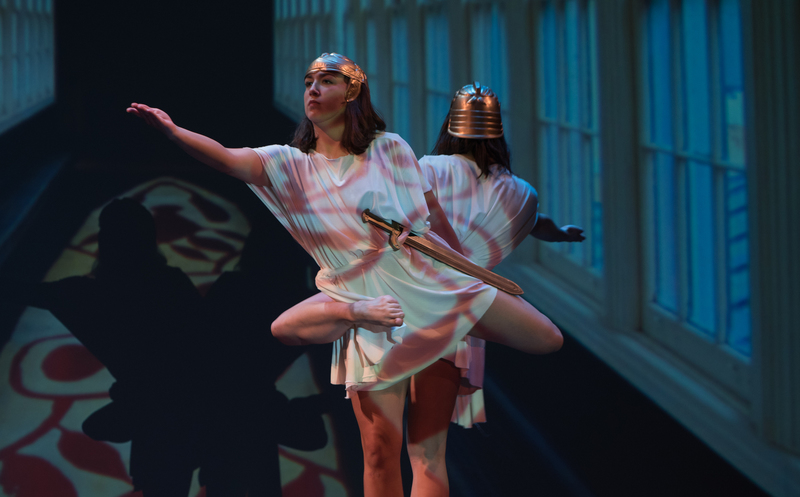
Julius Caesar Superstar takes us back in time to make a point about the present. The clownish Roman senators-among them the delightful Goldhuber, Thom Fogarty, and Rhetta Aleong (yes, a woman in drag), open the evening with lively and intricate  circle dances, red-trimmed togas aswirl. Their joyous dancing spans the length of Danspace's floor and, along with Kathy Kaufmann's lighting, opens it up and enlivens it in ways I've never seen before. In fact, nearly every part of the space gets pressed into service-the arched, stained-glass windows momentarily illuminated, the balcony visited by trumpeters to herald the approach of a war hero, the sanctuary steps turning into a sybaritic, raunchy display, the risers  transformed by a wide scrim into the steamy baths where towel-draped senators casually stroll, snooze, and plot revolution.

Julius Caesar Superstar, played by that good-looking ballet superstar Robert LaFosse (ABT, New York City Ballet, Tharp), is attended by bare-legged prancing soldiers. (Or should that be, soldiers with invisible prancing horses?) These are played, in snappy high spirits, by Arthur Aviles, Alberto Denis, Marcelo Rueda Duran, and Valentin Ortolaza, Jr. Let's support  our troops and praise these wonderful guys. Not only are they brilliant as Roman guards but they take other roles, too. As boy servants, for instance, they have their own ritualistic circle dance (with wine vessels) featuring comely, synchronized moves and delicate crossing steps. Goldhuber's work here is particularly gorgeous and witty. Later, the four will also play classical sculptures in the bath-how do they hold those contorted poses so long?-as well as Abu Ghraib-type  guards and political convention cheerleaders.

And then there's Micki Wesson, the real heavyweight of the show-moral heavyweight, that is. As the mysterious soothsayer, she points her crooked staff, silently speaking truth to power. She's got Caesar in her sights. He may cackle in scorn, but he's a goner.

The senators, realizing that Caesar is a drunken, power-mad libertine, begin to plot against him, distancing themselves from him as he lolls about in the steam of the bath. For some dazzling moments, the scrim displays a black-and-white video of LaFosse's face with a paranoid or death-mask expression. The image is huge. Its cold glow spills from the scrim onto the wooden floor, making the entire scene vibrate with light.

Fast forward to America of the McCarthy-ite '50s. Caesar, stripped down to a loincloth, gets roughed up by a pack  of senators (wardrobe updated to slacks, shirts, suspenders, and ties). He's stabbed numerous times. Goldhuber kisses him square on the mouth-hard and long-before driving home the fatal wound. Caesar survives long enough to play out a rather involved death scene culminating in a beauty of a duet with Keely Garfield as a severe but loving Lady Macbeth.  What? You don't think that Lady Macbeth might greet Julius Caesar at Death's door and help him cross over? Listen, they're terrific together!

In the twinkling of an eye, we're at a red-white-and-blue political convention complete with sparkling confetti.  Which party? Maybe it doesn't matter. But the big number-"Can't You Feel the Brand-New Day?"-intensely  sung by conventioneers who seem just short of rage, is entirely too reminiscent of Bush's oft-repeated "Freedom's  on the march in Iraq!"

Goldhuber now wears Caesar's wreath. Meet the new boss. Same as the old boss.
©Eva Yaa Asantewaa, http://home.mindspring.com/~magickal1/


By DEBORAH JOWITT

You can't exactly say that Lawrence Goldhuber is coming out as a fat dancer. He did that without explanation years ago in the company of Bill T. Jones and Arnie Zane. And we loved him for it. But in When the World Smells Like Bacon, part of his P.S. 122 program earlier this month, Goldhuber good-humoredly explained his heredity (holding up pictures that showed the achievement and disappointing aftermath of his teen years in weight reduction camps) and humiliating performing experiences, while tantalizing us with the smell of bacon he's frying up for a BLT. Just so we know what he feels like every day. He also runs us through his career as a successful heavyweight in a collage of '80s TV commercials edited by David Brooks. He's a knockout as the Lotus salesman leading an entire office staff in a jubilant, it's-changed-our-lives dance.

Goldhuber uses his size (and gender) to more poignant effect in the 1998 Soy (I am) choreographed with erstwhile partner Heidi Latsky. In this he's an old woman in a head shawl, holding a guitar and undulating massive hips, while Lola Beltran's taped voice sings mournfully of solitude. Scrubbing the floor with her skirt, reverently covering her guitar with her scarf, this woman enters your mind and won't get out. Goldhuber reminds us how wonderfully Jones featured his bulk in a sad King Kong solo from Jones's 1992 Love Defined.

Some pieces have nothing to do with Goldhuber's physique. In Gretchen Bender's film Head Duet, he and Latsky nuzzle each other and entwine lovingly, the camera watching from very close or from above. In the charming new Dances With Wolves, he and Keely Garfield play off one another in a sour Fred-and-Ginger routine, the pair's superb comic timing and performance subtleties a delight. Amid clever white fabric columns by Gisela Stromeyer, they traverse the dance floor with tiny, well-behaved steps that include a little rhythmic hiccup as a sign of trouble to come. He lifts her, and both look pleased. Next minute, they're yanking each other into huge, clumsy leaps. Refinement only temporarily masks rage and confusion. In the end, she shreds his credit card. FEBRUARY 27, 2001


7 Choreographers Pick a Sin and Run With It

By JENNIFER DUNNING

BECKET, Mass. — A good time was had by nearly all on Sunday afternoon when "The Seven Deadly Sins" spilled out across the stage of the Ted Shawn Theater at the Jacob's Pillow Dance Festival. Many in the audience rose in a standing ovation. And the performers and choreographers seemed to have had a lot of fun putting this oddity together. But the parts amounted to less than one might have expected.

Ballet choreographers have been drawn like lemmings to "The Seven Deadly Sins" since the 1933 production by George Balanchine, Bertolt Brecht and Kurt Weill. Always difficult, the piece has now drawn seven modern-dance and Broadway choreographers, each of whom chose a sin and created a free-standing dance of 10 minutes or less in a well-staged suite. Some episodes were fascinating. Most had little to do with the sin at hand.

Richard Move's "Lust" was the most Brechtian of the pieces, and Mr. Move drew a stunning performance from Helene Alexopoulos, a principal dancer with the New York City Ballet. A Dresden shepherdess of a ballerina, Ms. Alexopoulos was a figure of broken sensuality in a long, slow-moving solo in which she remained in a pitiless spot of white light at the front of the dark stage.

Taped phone-sex advertisements and conversations set the context before they were overtaken by crackling static. Dressed in a delicately sexy black-and-white body stocking designed by Pilar Limosner, Ms. Alexopoulos seemed at first glance a beautifully lithe creature who oozed the requisite heat.

Mr. Move made the most of the ugliness of ballerinas' knotted feet, however, slowly allowing Ms. Alexopoulos's large bare feet and hands and weirdly double-jointed arms to take over the dance. By the end, as she reached out in a beautifully timed split- second appeal, Ms. Alexopoulos seemed a malfunctioning robot as devastating as Paul Taylor's Big Bertha but full of pathos, a lost object of anonymous lust.

The solo needed tightening. The brief appearance of two paparazzi was puzzling. Mr. Move needs to upgrade the black wig, and Ms. Alexopoulos should shed her wedding ring at the next performance. But this was otherwise first-rate work from both.

Chet Walker's "Anger," set to music by Astor Piazzolla, was a seething Broadway tango danced by Ms. Alexopoulos, Robert La Fosse, Desmond Richardson and Rasta Thomas, an exquisite young ballet dancer too seldom seen on New York stages. Annie-B Parson created a complete bizarre little world in "Greed," set to music by John Zorn and Weill, in which five women squabbled over several small well-chosen props. The wonderfully brazen performers were Tymberly Canale, Molly Hickok, Kate Johnson, Krissy Richmond and Rebecca Wisocky, the Sandra Bernhard of dance.

Dancing Hershey Kisses, brilliantly costumed by Liz Prince, were a high point of the afternoon in Lawrence Goldhuber's "Gluttony," set to music by Mark Mothersbaugh and Yello. Their giddy bourrées and Chinese ribbon dancing were brilliantly conceived by Mr. Goldhuber, who, dressed in a fat suit, fell asleep at a picnic and dreamed of a priapic hot- dog and two nuzzling drumsticks.

David Dorfman's "Sloth" got off to a witty start but soon fell apart in a tangle of clever in-jokes and other verbal play. And Jamie Bishton's "Envy" would have been much stronger if he had limited the piece to the audition it started out as. Mr. La Fosse's "Pride," set to music by C&C Music Factory with appropriately fabulous costumes by Karl Lucifeld, was a knock-'em-dead finale, complete with mirror ball and gold curtain. But less naïve nose-thumbing would have made "Pride" even more fun.

The dynamic lead cast was completed by Paul Matteson and Stephanie Liapis.       July 17, 2001


DEEP with Keely Garfield.........photo: Dona Ann McAdams


FOR MORE INFORMATION, PLEASE WRITE: goldhuber@goldhuber.com

Top