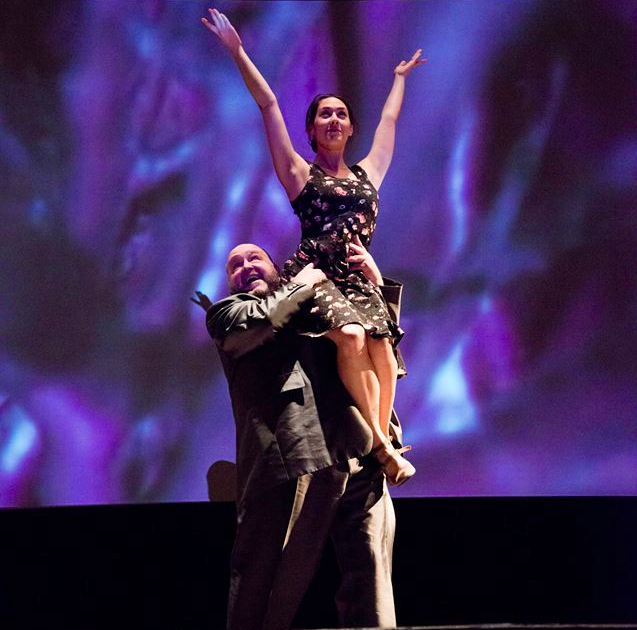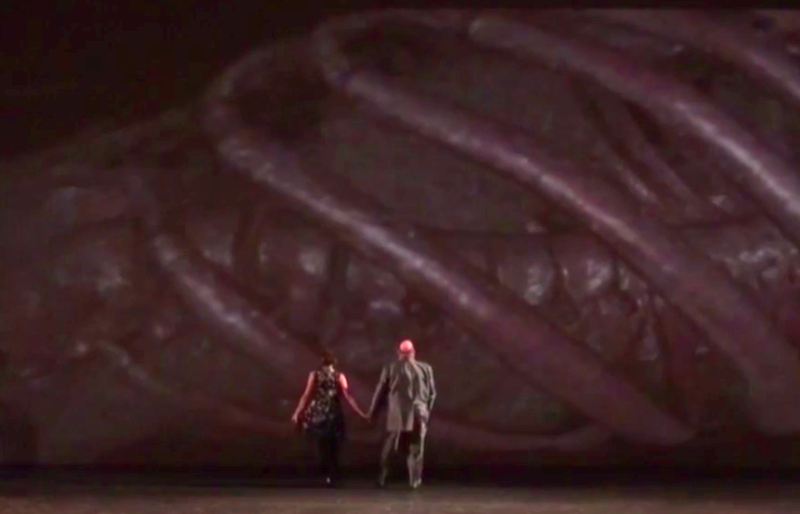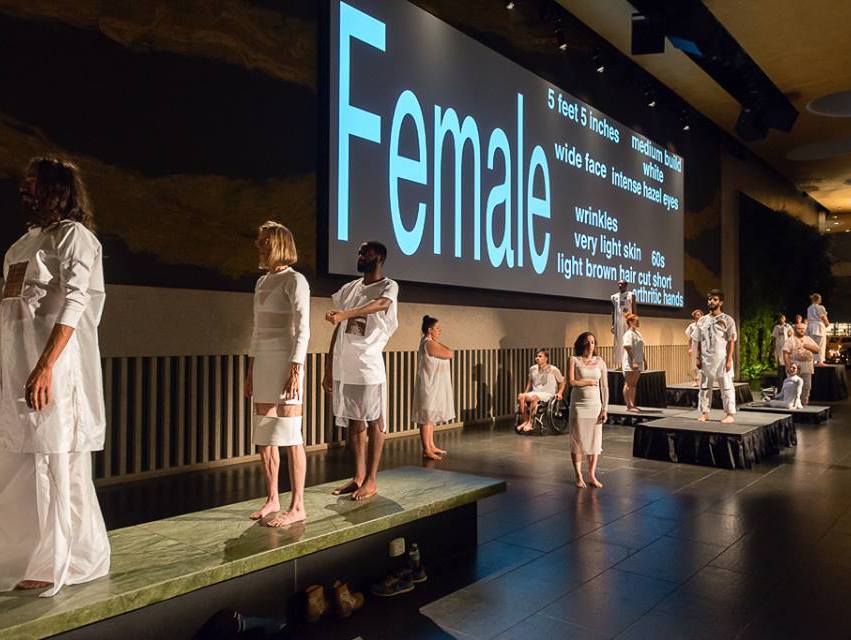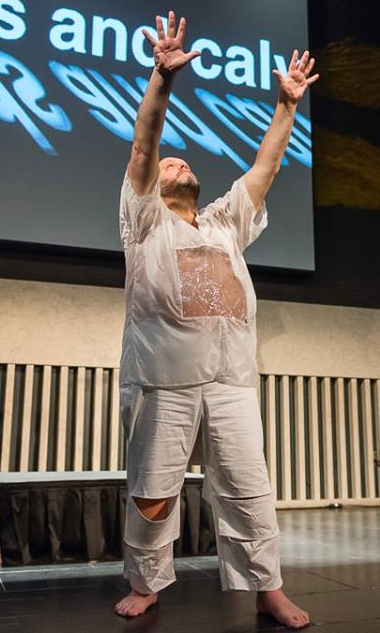
| | "...a terrific romp...a joyous, giddily epicine gathering..." The New York TImes
"a highly entertaining hourlong dance piece distinguished by biting humor, stunning visual effects, and slyly crafted movement drama...a super show" Backstage
"a work that charmingly, sometimes recklessly, blends hilarity, tragedy, and camp" The Village Voice
"a great, sweeping work that comes on like a vest-pocket Broadway smash" Dancing with Eva Yaa Asantewaa

CLICK THIS PIC TO WATCH VIDEO EXCERPTS FROM JULIUS CAESAR SUPERSTAR
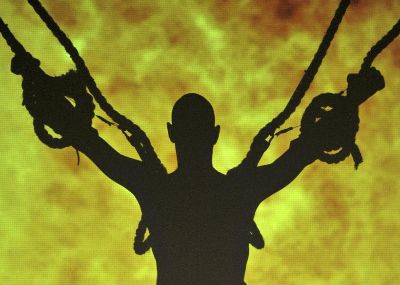
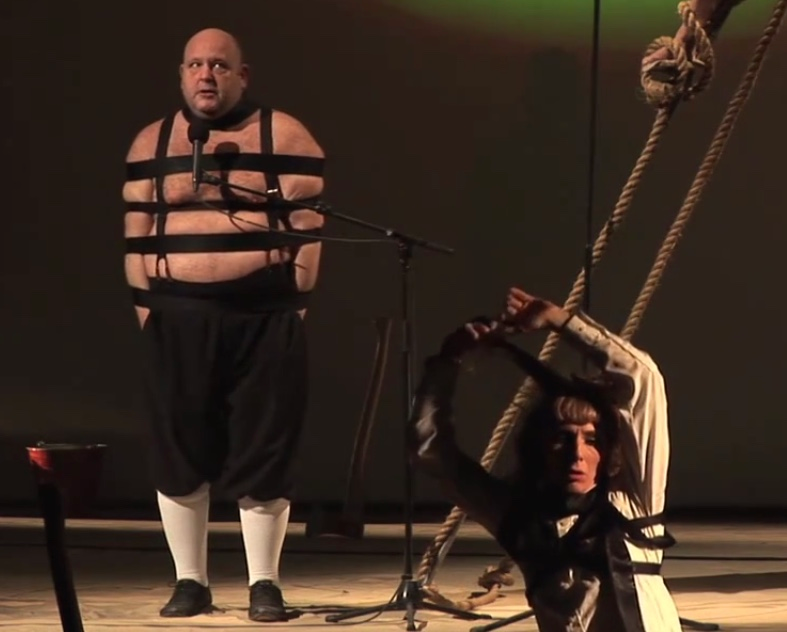
JULIUS CAESAR SUPERSTAR features ballet star Robert La Fosse in the title role, surrounding him with eight 300-pound performers as the conservative senators who murder him. The show, choreographed, and directed by Lawrence Goldhuber, moves from the Roman baths through to the U.S. Senate of 1950's McCarthyism, with ambition, power, and betrayal around every corner. Original music by Geoff Gersh (of Straylight) is combined with excerpts from previous interpretations of the Caesar story to deliver a driving soundscape. The cast includes musicians, a soothsayer, muscled men performing as soldiers, slaves, and statues, as well as a surprise appearance by the evil Lady Macbeth who escorts our hero to the afterlife. Vibrant costumes are designed by frequent collaborator Liz Prince. Gregory L. Bain's sleek production design and Kathy Kaufman's brilliant lighting complete the creative team.
Robert La Fosse in the baths
Photo: James Schriebl Photography
Robert LaFosse as Julius Caesar
Photo: James Schriebl Photography

DANSPACE PROJECT and BIGMANARTS
present
JULIUS CAESAR SUPERSTAR
Choreographed and Directed By Lawrence Goldhuber Original Music By Geoff Gersh Additional music by Handel, Vivaldi, and Vandross Video By Janet Wong Lighting Design By Kathy Kaufmann Costume Designs By Liz Prince Technical Director: Mandy Ringger Editing Advisor: Valeria Vasilevski Assistant to the Choreographer: Tony Wicks
Technical support: Mitchell Wagenberg / Street Vision
Starring (in alphabetical order):
Rhetta Aleong, Arthur Aviles, Sydney Boone Eric Stephen Booth, Alberto Denis, Loren Kiyoshi Dempster Marcelo Rueda Duran, Thom Fogarty, Keely Garfield Lawrence Goldhuber, Robert La Fosse, Rosalynde LeBlanc Valentin Ortolaza, Hapi Phace, Micki Saba, and Micki Wesson

Lawrence Goldhuber as Brutus
Photo: Chang W. Lee/New York TImes

Members of Lawrence Goldhuber's Bigmanarts troupe
swirling their togas in "Julius Caesar Superstar" at Danspace Project
on Thursday night. Photo: Julie Lemberger/New York Times


By JENNIFER DUNNING
There is nothing quite like a dancing chorus of agile 250-pound men in togas. Who would have known it, though, if not for Lawrence Goldhuber and his new "Julius Caesar Superstar," which opened on Thursday at the Danspace Project at St. Mark's Church.
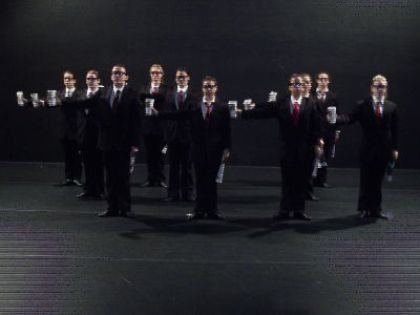
Performed by Mr. Goldhuber's Bigmanarts company, the piece depicts the murder of Caesar, followed by a duet for Caesar and Lady Macbeth, who escorts him to the netherworld. Dressed in modern-day business suits by now, the senators return with Caesar's guards for a rousing performance of a song called "Can't You Feel the Brand-New Day?" American flags wave, and a shower of red-and-white confetti ends the hourlong show.
If this is meant to be sociopolitical commentary, and apparently it is, the most pointed moment of wit comes as one senator (Hapi Phace) enthusiastically signs the song at the side of the group. But "Julius Caesar Superstar" is simply a terrific romp at heart. It is also a handsome-looking show, particularly in a scene in which a video of Caesar's grimacing, smiling, revolving head is projected on a scrim that the senators plot behind in the baths. Liz Prince's vividly stylish costumes are inspired.
Most of all, this is a joyous, giddily epicene gathering of the downtown-dance clan to which everyone is invited, from the audience to the uptown ballet star Robert La Fosse, who plays Caesar, and the dance patron Micki Wesson, who anchors the evening with her gravitas as a soothsayer and a judge.
There are poignant moments, chiefly in a solo for the dying Caesar and in his duet with Lady Macbeth, played by a deliciously poker-faced Keely Garfield. Thom Fogarty brings a bracing simplicity to his senator, and Arthur Aviles is enjoyably cheeky as a guard.
Published: May 14, 2005
Caesar Returns
Photo: James Schriebl Photography
Baccaenal
Photo: James Schriebl Photography


Lawrence Goldhuber is an ingenious theatrical director. His latest production, "Julius Caesar Superstar," is a highly entertaining hourlong dance piece distinguished by biting humor, stunning visual effects, and slyly crafted movement drama.
Presented at St. Mark's Church, the work makes exquisite use of the venue's spatial idiosyncrasies to create marvelously atmospheric settings, including a steamy Roman bath (complete with sensuous nude "statues"), a frightening McCarthy-era courtroom, and a rousing Republican National Convention. Goldhuber's version of Caesar's story begins historically -- featuring a cast of eight 300-pound performers as the conservative senators who betray their leader, apparently because of his overappreciation for homoeroticism. However, Caesar's murder takes place at a trial held in the conservative climate of 1950s America, and the fat men's victory celebration is depicted as today's Republicans hailing the conservative politics of George W. Bush. In what is perhaps the funniest finale we've ever witnessed at a dance performance, Goldhuber sends his "fat cats" into a patriotic hullabaloo of a production number. They sing and dance gleefully to a sickeningly upbeat pop song as flags wave, confetti falls, and a cheesy sign-language interpreter performs to hilarious effect.
The choreographic highlight of Goldhuber's work occurs just after the killing of Caesar. Portrayed by ballet superstar Robert La Fosse, whose graceful, boyish interpretation of the role appropriately imbues the powerful character with a haunting vulnerability, Caesar is visited in the afterworld by Lady Macbeth. They dance an edgy pas de deux built of engagingly off-kilter actions suggesting betrayal, guilt, and fear.
Enhanced by Geoff Gersh's original music, Liz Prince's right-on-target costumes, and Janet Wong's penetrating video of Caesar's oversized, agonized countenance, "Julius Caesar Superstar" is indeed a super show.
Blind Justice
Photo: James Schriebl Photography

Review No. 25 Posted: May 16, 2005 Lawrence Goldhuber/BIGMANARTS Danspace Project May 13, 2005
Exhilarating! Lawrence Goldhuber's new dance drama, Julius Caesar Superstar, does everything on a grand scale. Sure the piece has a cast of heavyweights playing Roman senators who, like the famously portly Goldhuber, carry considerable heft either through natural endowment or fat-suit enhancement, but that's not what I'm talking about.
By "everything" I mean choreography, musical score, video, lighting, and costumes-all contributing generously to a great, sweeping work that comes on like a vest-pocket Broadway smash, all packed into the space of an hour. The production moves swifter than you might expect and never flags-just like Goldhuber and his senatorial co-conspirators. Even its excesses seem purposeful. That's some kind of magic!
Julius Caesar Superstar takes us back in time to make a point about the present. The clownish Roman senators-among them the delightful Goldhuber, Thom Fogarty, and Rhetta Aleong (yes, a woman in drag), open the evening with lively and intricate circle dances, red-trimmed togas aswirl. Their joyous dancing spans the length of Danspace's floor and, along with Kathy Kaufmann's lighting, opens it up and enlivens it in ways I've never seen before. In fact, nearly every part of the space gets pressed into service-the arched, stained-glass windows momentarily illuminated, the balcony visited by trumpeters to herald the approach of a war hero, the sanctuary steps turning into a sybaritic, raunchy display, the risers transformed by a wide scrim into the steamy baths where towel-draped senators casually stroll, snooze, and plot revolution.
Julius Caesar Superstar, played by that good-looking ballet superstar Robert LaFosse (ABT, New York City Ballet, Tharp), is attended by bare-legged prancing soldiers. (Or should that be, soldiers with invisible prancing horses?) These are played, in snappy high spirits, by Arthur Aviles, Alberto Denis, Marcelo Rueda Duran, and Valentin Ortolaza, Jr. Let's support our troops and praise these wonderful guys. Not only are they brilliant as Roman guards but they take other roles, too. As boy servants, for instance, they have their own ritualistic circle dance (with wine vessels) featuring comely, synchronized moves and delicate crossing steps. Goldhuber's work here is particularly gorgeous and witty. Later, the four will also play classical sculptures in the bath-how do they hold those contorted poses so long?-as well as Abu Ghraib-type guards and political convention cheerleaders.
And then there's Micki Wesson, the real heavyweight of the show-moral heavyweight, that is. As the mysterious soothsayer, she points her crooked staff, silently speaking truth to power. She's got Caesar in her sights. He may cackle in scorn, but he's a goner.
The senators, realizing that Caesar is a drunken, power-mad libertine, begin to plot against him, distancing themselves from him as he lolls about in the steam of the bath. For some dazzling moments, the scrim displays a black-and-white video of LaFosse's face with a paranoid or death-mask expression. The image is huge. Its cold glow spills from the scrim onto the wooden floor, making the entire scene vibrate with light.
Fast forward to America of the McCarthy-ite '50s. Caesar, stripped down to a loincloth, gets roughed up by a pack of senators (wardrobe updated to slacks, shirts, suspenders, and ties). He's stabbed numerous times. Goldhuber kisses him square on the mouth-hard and long-before driving home the fatal wound. Caesar survives long enough to play out a rather involved death scene culminating in a beauty of a duet with Keely Garfield as a severe but loving Lady Macbeth. What? You don't think that Lady Macbeth might greet Julius Caesar at Death's door and help him cross over? Listen, they're terrific together!
In the twinkling of an eye, we're at a red-white-and-blue political convention complete with sparkling confetti. Which party? Maybe it doesn't matter. But the big number-"Can't You Feel the Brand-New Day?"-intensely sung by conventioneers who seem just short of rage, is entirely too reminiscent of Bush's oft-repeated "Freedom's on the march in Iraq!"
Goldhuber now wears Caesar's wreath. Meet the new boss. Same as the old boss. ©Eva Yaa Asantewaa, http://home.mindspring.com/~magickal1/
Micki Wesson as The Soothsayer
Photo: James Schriebl Photography


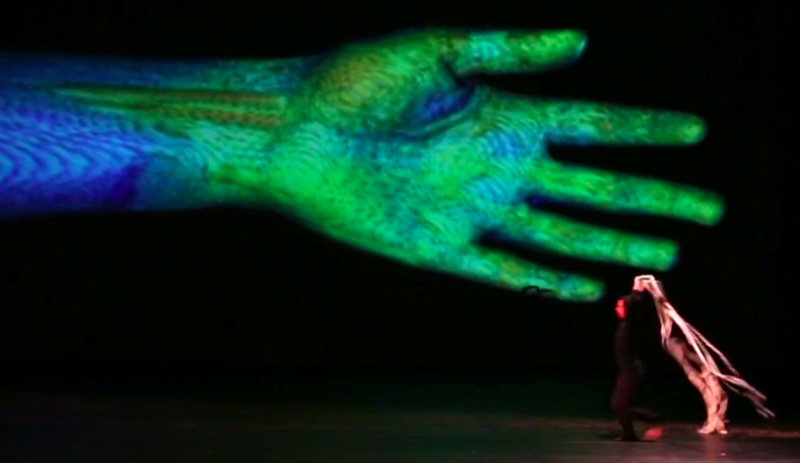
As an actor-dancer-choreographer of impressive avoirdupois, Lawrence Goldhuber decided-no surprise-to skewer the fat cats who control U.S. national and international policy by casting men who weigh in (Sidney Boone, Eric Stephen Booth, Thom Fogarty, Hapi Phace, and himself) plus two women in fat suits (Rosalynde Leblanc and Micki Saba) as the conservative Roman senators in his new Julius Caesar Superstar. Only two of the men (Fogarty and Goldhuber) are trained dancers, but all cavort to Vivaldi in senatorial games- backstabbing through a grand right and left, circling gaily, playing patty-cake, ending with an all-fall-down. Liz Prince's voluminous, red-bordered white togas fly in the wake of these elephantine negotiations. Goldhuber's Caesar is not Shakespeare's. Although golden-boy ballet star Robert La Fosse, up on the church balcony flanked by trumpeters, does indeed "thrice refuse a kingly crown" (offered by a disembodied hand), he's not so much impelled by modesty as he is holding out for the prettiest coronet. In a work that charmingly, sometimes recklessly, blends hilarity, tragedy, and camp, Caesar's greatest sin seems to be that he's thin, gay, and just a teeny bit arrogant. Not your picture-book liberal. His circle of pique turns could make a stout fellow jealous, although the senators all mime, "You were great!"
It's when the miniskirted guards (Alberto Denis, Marcelo Rueda Duran, Valentine Ortolaza Jr., and the wonderfully nimble, ardent Arthur Aviles) remove their breastplates, bow low to expose their bare butts, and start massaging Caesar that the senators leave in shock. Too proud (and maybe too aroused) to listen to the small, white-haired female soothsayer (Micki Wesson in a fine, stern performance), Caesar falls back and the guards swarm over him. Ides of March? No big deal.
Rumors grow during a visually alluring bathhouse scene, with towel-draped senators hanging out on the risers opposite the audience. The translucent drop in front of them and Kathy Kaufmann's lighting convey a steamy atmosphere, and conspiratorial whispers invade Geoff Gersh's dramatic score, some of it played live by cellist Loren Kiyoshi Dempster. Before long, the emperor is blindfolded, stripped, stabbed with switchblades, and left on the floor in a tangle of red ribbons. His, however, is an operatic death. Handel's famous "Largo" rouses him to back somersaults and attitude turns, and he expertly reprises all the action-the prancing soldiers, the false-friend senators, his own hubris-before collapsing for good. Whoops, not yet. Enter Keely Garfield as a quietly imperious Lady Macbeth. When she's not scrubbing at her hands, she's making Caesar support her in a pas de deux, after which he's ready to be led off to Hades through a poof of smoke.
In a somewhat heavy-handed stars-and-stripes finale, the jolly right-wingers belt, "The sun is shining just for us!" and confetti rains down. Come back little Caesar!
MURDER
Photo: James Schreibl Photography

Lawrence Goldhuber knows how to put on a darn entertaining good show, and bless him for that. His "Julius Caesar Superstar" was not the most profound or sophisticated of performances, but it was highly theatrical, imaginatively designed, and the performers delivered their material with gusto and flair. They also seemed to be enjoying themselves tremendously in the process.
In its closing minutes it suddenly veered in the direction of message-laden theater that did not seem fully justified by what had come before, but its turn towards the blatantly political was also accomplished with such good cheer and mock-showbiz trappings that one hardly felt like one was being hit over the head.
On Broadway, it is the role of Marc Antony that is currently being played by a superstar-Denzel Washington-but in Goldhuber's one-hour dance-drama telescoping and sending up the Shakespearean play, it was the eponymous returning warrior that is played by the brilliantly cast Robert LaFosse. While he has a level of dance-world recognition from his many years as a principal with both ABT and NYCB that gives him the air of visiting royalty in a downtown performance, he also has often collaborated with innovative choreographers and performance artists far removed from the world of Lincoln Center. So while he could convincingly exude an air of patrician nobility and triumphal acknowledgement as he gestured loftily toward the masses from a balcony, he also sustained a sly sense of complicity in the generally campy approach of the goings-on.
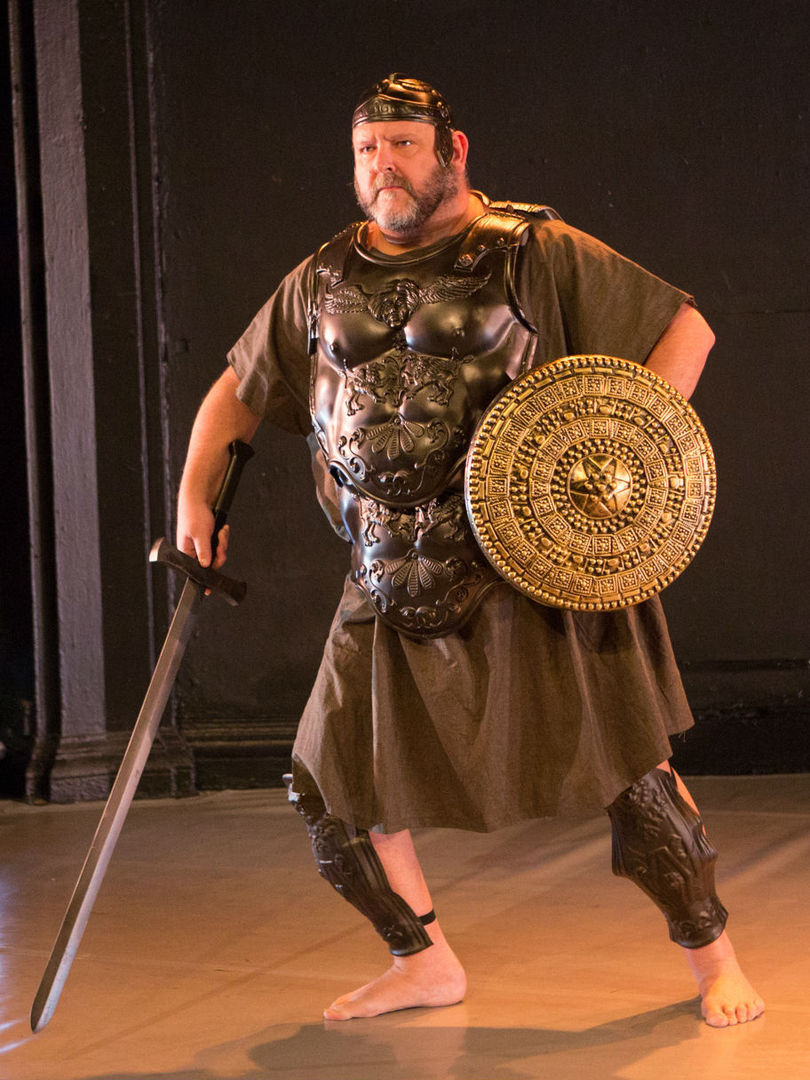
Goldhuber, who brought his distinctive rotund vigor and witty presence to the works of Bill T. Jones before heading off to shape his own projects, assembled a diverse cast of 16 that included many performance veterans and strong, distinctive presences. Eight of them, including Goldhuber, portrayed the Roman senators, and they were cast for their size and girth. Taking a cue from Caesar's mistrust of Cassius with his "lean and hungry look" and his desire to "have men about me that are fat," these conspirators are galumphing hefties, artfully draped in size XXX togas trimmed in red (hinting at their bloody intentions?). Three of them were actually women, with heavily padded fat suits required to fill out their proportions. Their introductory group dance, set to Handel's exuberant "Arrival of the Queen of Sheba" (from "Solomon") was a deliberately simply folk-flavored romp that has the giddy guilelessness of kids at play. They lurched, rocked from side to side, and ended by tumbling with relief to the floor.
If we were meant to see these supposedly powerful and influential senators as lumbering fools, we were certainly not meant to view Caesar as a serious and effectual leader. His arrival announced by heralds, La Fosse appeared on the St. Mark's balcony, in a gilded toga and red cloak, going through the rote, vacant posturings of a politician accepting his nomination. He entered the main space below ushered in by four pretty-boy centurions in gleaming breastplates and simply white skirts. In his delightfully preposterous solo, La Fosse skillfully suggested a heroic imbecile. He must have had a grand time mentally reliving various heroes from his ABT days, as he performed Goldhuber's good-natured send-up of such roles-culminating in a pose with the four muscular young guys artfully reclining around him.
The versatile foursome then shed their breastplates to become nubile slaves to the indolent, debauched Caesar and the pompous senators, who lazed around the St. Mark's altar with an air of entitlement. La Fosse seemed to have a grand old time reclining on a settee, consuming a bunch of grapes, and alternately summoning and dismissing the ever-more-willing slaves. But he had to confront reality in the form of a hunched, fierce soothsayer (Micki Wesson) at whom he laughed scornfully but engaged in a physical tussle.
For the succeeding scene, three of the muscular guys posed naked in artful profile as the décor of The Baths, where the senators lazed around and presumably hatched their conspiracy. The amalgam of Roman and gay bathhouse was cleverly and cheekily evoked, behind a filmy sheet of fabric, on which was haunting video of Caesar's troubled, fearful face in close-up and profile was then projected.
For the "Hearing" in which Wesson served as a ceremonial judge, the senators became contemporary men, dressed in dark suits. La Fosse became more like Jesus Christ Superstar in this scene, wearing a glorified gleaming loincloth and posing in a crucifixion posture and exuding a sacrificial air. The senators surround him, attacking him with literal red tape, which they wrap around parts of his body, until he falls, lying on the ground in utter silence. When he rises, it is to perform a wrenching solo that clearly alludes to that of Balanchine's "Prodigal Son" in his direst moment, after being tormented and abandoned. Dazed and unsteady, barely able to rise, La Fosse performed this sequence with the utmost seriousness and focus.
Suddenly, a burst of smoke in the church's entryway deposited the divinely morose and slightly kooky Keely Garfield, as Lady Macbeth (she makes sure we recognize her identity by rubbing her hands feverishly). She stumbled and looked disoriented (as if to say, "hold on a minute, I'm in the wrong Shakespearean drama here") before coming to La Fosse's aid, a figure of succor and melancholy acceptance. This was accompanied by eerie, throbbing electrified cello music (Geoff Gersh performed his score live on cello from a corner, interspersed throughout the evening with recorded Baroque selections).
The incongruous, if entertaining, final scene brought the now-contemporary senators and younger guys back in full patriotic garb-plenty of red, white and blue, including sashes and party hats-to sing about a "brand new day" while confetti fluttered from above. This abrupt switch and implied political commentary didn't quite add up, and whatever parallels or allusions are being made to the shallow fat cats of the current political scene are not drawn all that convincingly. But Goldhuber (with a strong assist from Liz Prince's costumes) had certainly offered us a deliciously enjoyable and sweetly unpretentious pageant along the way.
Volume 3, No. 20 May 23, 2005 copyright ©2005 Susan Reiter www.danceviewtimes.com

La Fosse and Goldhuber
Newsday photo by: Scout Tufankjian
IT'S THE GREATEST SHOW ON GIRTH In 'Julius Caesar Superstar,' director Lawrence Goldhuber hopes a fat chorus has wide appeal
BY APOLLINAIRE SCHERR
'Let me have men about me that are fat," Caesar said, and Lawrence Goldhuber has finally supplied them.
For "Julius Caesar Superstar," director-choreographer Goldhuber borrows from history - the Roman Senate and the red-baiting U.S. Senate of the 1950s; the ancient Roman baths and the American gay bathhouses of the late '70s; and from films and literature, as various as Dante's "Inferno" and "The Wiz." The result is a surreal, alternately creepy and sexy dance-theater piece about power, paranoia and sacrifice and the shapes they take in our minds and the world.
A heavyweight Senate
One of the shapes they take in "Julius Caesar Superstar" is of a chorus of eight senators, each of whom weighs at least 300 pounds - or, if not, is stuffed into a fat suit. In fashioning the sweeping togas for these bulky men and women to reel and raise their fists, costume designer Liz Prince ran out of fabric three times.
"The striking imagery of eight big people dancing, I assume we've never seen before," Goldhuber says.
At a recent rehearsal, the chorus members admitted that they didn't expect to be dancing so much. "I haven't shook my booty since the '70s," said a graying Eric Booth.
At 6 feet and 350 pounds, Goldhuber has always specialized in girth. In 1985, the lanky dancer-choreographer Bill T. Jones hired Goldhuber, then an actor with no formal dance training, because Jones wanted "someone who made him feel small," he says. Goldhuber's presence in the company ended up rearranging audiences' thinking about what a dancer could look like.
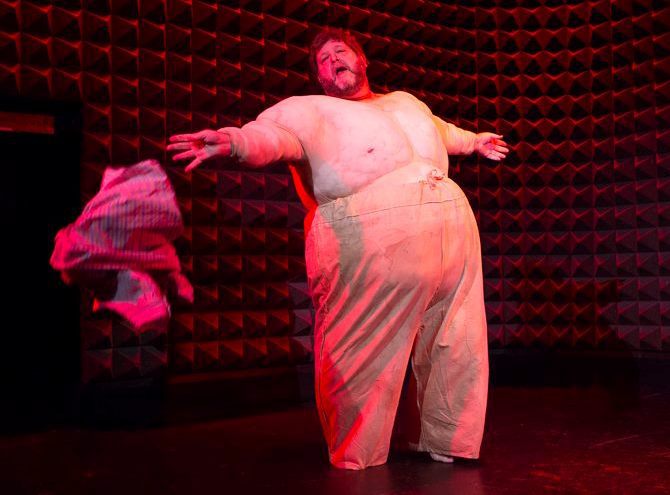
In the independent career Goldhuber embarked on in 1996, he has played up his size and taken on every imaginable fat stereotype. He has swathed himself in a fat suit and performed with dancer Heidi Latsky, barely 100 pounds and 5 feet tall. He has dressed as a baby in diapers. For a solo outing at P.S. 122 last year, he invented Barry Goldhubris, man of outsized ego.
Critics have played along, freely designating him "extremely hefty," "unapologetically bulky," "of Falstaffian proportions," "tubby," "mountainous" and "vast." They have also noted, with evident astonishment, that he dances "like an angel."
Asked about his subversive strategy, the native New Yorker says he doesn't have one. "I suppose I'm just harping on the feature that makes me unique in modern dance," he muses. "It's hard enough to stand out in dance - a highly populated and competitive field."
But "Julius Caesar Superstar" is sneaky, like Goldhuber's other work. It introduces stereotypes only to have them grow complicated.
At the start, the eight senators are "a bastion of power," Goldhuber says, "like on a golf course." Except in this case, it's a bathhouse. (He easily cops to the show's gay subtext.) In one scene, the men recline behind a scrim in skimpy towels while Geoff Gersh's inventive score conjures the bath's heat and drip. Four hunks in flimsy white miniskirts pose as Roman statues.
Ballet golden boy
At the center of the drama is one of ballet's all-time golden boys, Robert La Fosse. "I thought," Goldhuber explains, "'What superstar do I know?'" He has known La Fosse since the humongous early '90s "Wigstock" celebrations of drag queens and their hairdos. The blond, gamin dancer, now 45, is more widely known from his decades with American Ballet Theater and later the New York City Ballet (where he now guest-stars in character roles), or from his Tony-nominated performance in "Jerome Robbins' Broadway" in 1989. "I say, 'Can you do a turn here?'" Goldhuber recalls, "and Robbie whips out a triple pirouette."
La Fosse does not envision Caesar as a cocky ballet star, however, nor as a man who "doth bestride the narrow world like a colossus" (as Shakespeare put it). Rather, this is someone whose high worth has driven him to a paranoia that even assassination threats don't entirely justify.
When La Fosse descends to the underworld after being engulfed by the mass of senators, he dances - solo and with a bewitching Keely Garfield - as if he were finally freed from a hall of mirrors and even his own reflection.
In a rousingly disorienting finale, which seems to take place at one of President George W. Bush's 2004 campaign stops (and over Caesar's dead body), the chorus also transforms. They no longer seem like fat cats. As Shakespeare's Caesar pointed out, the truly dangerous have "a lean and hungry look." These patriotic flag-wavers are only the operatives, misled about their targets and their pride.
Apollinaire Scherr is a freelance writer. May 9, 2005
La Fosse and Goldhuber
Newsday Photo by Scout Tufankjian
Keely Garfield as Lady Macbeth with Robert La Fosse as Caesar
Photo: James Schriebl Photography
Brand New Day
Photo: James Schriebl Photography
Arthur Aviles, Valentin Ortolaza, Alberto Denis
Great Caesar's Ghost! Goldhuber
in the Baths with LaFosse & Julius
By Philip W. Sandstrom Copyright
2005 Philip W. Sandstrom
Lawrence Goldhuber is a choreographer,
dancer, actor, and performance artist who has worked in New York for
more than 20 years. His new "Julius Caesar Superstar" opens Thursday at
Danspace Project at St. Mark's Church.
Philip Sandstrom: What was
your motivation for creating your "Julius Caesar Superstar" show? What
was the impetus?
Lawrence Goldhuber: The first motivation was the
space itself -- actually, the very first motivation was the Jerome
Foundation, from whom I received funding for my last project,
"Goldhubris." They tend to fund in cycles; you have to think about your
next show or shows well in advance. If you want to be eligible for a
grant, you have to propose ideas two years before your show. When you're
working on one show you have to be thinking about the next show.
PS:
So you pitched several projects to Jerome simultaneously?
LG:
No, almost exactly two years ago, I was sitting in St. Mark's Church,
thinking about developing my next project, so I could apply for Jerome
funding. While sitting there I gazed at the columns and thought "Roman
Baths," then: Caesar, I could do a piece on Caesar! Around the same
time, I had just finished a solo project with text, and was now thinking
of moving away from a solo show and doing a dance piece with a large
cast, with no text. So I thought of a dance version of Julius Caesar. I
was trying to think of someone noble, I was trying to think of my
biggest celebrity friends. First I thought of Bill T. Jones, but I know
he's way too busy. I had recently become friends with Robert LaFosse and
thought, He's perfect for the central (Caesar) role!
Funding was
the impetus. The grant writing I've been doing usually focuses on my
size, that being the most unique thing about me in modern dance, that is
the niche I've carved out, exploring issues of body fascism and
self-acceptance, due to my size. It's not something that weighs
heavily....
PS: (Chuckle.)
LG: .... Heavily being the key
word. It's an aspect of my life, so I won't deny it. One may look at the
body of my work and think I'm obsessed with it, but I'm really not,
it's just the niche market that I found myself in.
PS: People,
audience and critics alike, tend to pay more attention to you and your
size because it is so unique in dance.
LG: Exactly, you've got to
play the guitar you're given. Along those lines, I thought of the bath
house filled with all these big fat men, the image of the corporate fat
cat; the power base of America, if not the world. So, I came up with the
idea that all the senators are very fat, and they conspire to murder
the slender Caesar.
PS: (Chuckle.) So, the impetus was the
funding cycle and the inspiration was the church. Now you have this
great idea, where did you go from there? Did you base this work on the
play by Shakespeare? How did you fashion the piece?
LG: Both and
neither. So, I start out with the idea of Julius Caesar, get a copy of
the play, read it, get a copy of the movie, and watch it. The play,
after the first half, after Caesar is killed, becomes a military battle,
the two factions fighting each other for control; it's not very
dynamic.
PS: It is also very difficult to portray onstage.... It
can be boring.
LG: Exactly, and since I'm not using text, I felt
free; I don't have to follow Shakespeare's version of the story. There
is a Caesar story by Handel..., there's "Caesar and Cleopatra," there
are a number of Caesar stories. Caesar is an iconic legend so I can use
all of this as a basis for my play, my dance play. I use Caesar's
liberal attitude toward sex as his crime. There is a little gay orgy
that happens in the presence of the senators. They are horrified and
they oust him.
The narrative of my show is: we introduce the
senators; Caesar arrives and is crowned; there is a little bacchanal and
orgy; then there is a scene in a bath house where the senators conspire
against Caesar; then the trial scene where they murder him; then he
does a final "dance of death"; then Lady Macbeth enters and escorts him
to the afterworld; then the senators return and sing about a "brand-new
day" now that they have been liberated from the liberalism. Boom, one
hour, a very clear little narrative, almost a parable. It follows the
story, that he's been betrayed, but they're just the senators, no
Cassius or Brutus. There are the soldiers and the Soothsayer comes in
and s/he does say, "Beware the Ides of March." There are aspects of the
(classic) story but I don't adhere to all of it.
Casting helps;
by using Micki Wesson, even if people don't know her they've certainly
seen her because she is at every performance, she is so diminutive, and
she is an old woman. I don't have to ask her to act like an old woman, I
hate that onstage. She comes on in a robe with a cape; when she pulls
that hood off, half the audience is going to get such a kick out of it.
PS:
But she is a soothsayer!
LG: Exactly, it's perfectly cast.
That's what her presence is there for, doubled and doubly. The show's a
big pageant!
PS: You had mentioned that this show is a big
departure for you, after working and co-choreographing as the duet
company of Goldhuber & Latsky, then setting solo work on yourself.
Now you are choreographing and directing a company of about 20 dancers?
LG:
16 people. Big departure isn't entirely correct; I've worked with large
groups of people. I have made large pieces on groups of students; I
just got back for the University of Texas and that piece had 13 people
in it. I've done one like it at SUNY-Brockport. Caesar is only a
departure in that it's a 180-degree turn from doing a solo show. That's
why I think I call it a departure. It's a big spectacle.
PS: So
you are familiar with staging such a work due to your experience staging
large works at colleges. Are there any other challenges with creating
group work?
LG: I've also been in many plays and dance pieces
with large casts. The bigger challenge is producing large cast works,
e.g., trying to get 16 people together for rehearsals. I will not have
the entire cast together in a room until the technical rehearsal (in the
theater). I've been working in small groups since December. In
December, I started with Robbie on the solos; in February I made the
duet for him and Keely (Garfield); then in March, I made the work on the
soldiers; then in April, the senators; then this last week we started
putting everyone together, but still everyone has not been there (at any
one rehearsal).
PS: Because the people you've chosen are
extremely busy?
LG: Exactly, working professionals.
Unfortunately, there is not a large enough salary to be paid to get a
full-time commitment. But that being said, I'm actually paying a nice
salary for this sort of project, for the kind of salary this sort of
show usually pays. In the modern dance world, for these kinds of shows,
you get $100 a show, that's what it averages out to, no matter how long
you rehearse.
PS: I know in theater, when you do a showcase, you
barely get carfare!
LG: Speaking of theater, I got a call to be
in the new Elaine May Broadway show in the part of a big man who could
dance. I couldn't do it because it just went into previews last week and
I open (this) week --@*%&#@*^$ ?#!!!
Well, I'm inundated
with work here, producing work; the hardest part is the producing. It's
not only getting the people in the room, but also raising enough funds
to pay for them, for a lot of costumes, for original music, and then as
the director you also have to interact with all these people. I've got
meetings with the costume designer, the composer, with the technical
people, with the lighting designer. (Editor's note: Geoff Gersh composed
the score. Liz Prince designed the costumes, Gregory L. Bain the
production, and Kathy Kaufmann the lighting.) It's very exciting but
it's a tremendous amount of work; and on top of choreographing, I'm also
performing in the show.
PS: So, you create this show, it plays
at Danspace Project for four performances. Let's say someone, a
producer, wants the show. Could you recreate it with different people if
necessary?
LG: If they come up with the fee!
Philip
W. Sandstrom is a theater consultant who has worked in production and
lighting design, management, and producing, as well as a consulting
editor for 2wice Magazine. Disclosure: Philip W. Sandstrom and Laurie
Uprichard, the executive director of Danspace Project, have had a
near-familial relationship for a number of years.
The creation of JCS was made possible, in part, with funds from the Danspace Project's 2004-05 Commissioning Initiative with support from The Andrew W. Mellon Foundation
BIGMANARTS is supported by The Jerome Foundation in celebration of the Jerome Hill Centennial and in recognition of the valuable cultural contributions of artists to society.
JCS was created during a residency provided by The Joyce Theater Foundation, New York City, with major support from The Andrew W. Mellon Foundation.
The original and live music for this evening's performance was commissioned by The American Music Center Live Music for Dance Program.
JCS has received generous funding from The Bossak/Heilbron Charitable Foundation, The Harkness Foundation for Dance, and from many individual donors.
These performances are made possible in part by the Manhattan Community Arts Fund/New York City Department of Cultural Affairs, administered by the Lower Manhattan Cultural Council.
JCS is a sponsored project of the New York Foundation for the Arts (NYFA), a 501(c)3, tax-exempt organization founded in 1971 to work with the arts community throughout New York State to develop and facilitate programs in all disciplines.
These performances are dedicated to friend and colleague Gretchen Bender, who passed away this winter. She was to have participated in the creation of this show and she is greatly missed.
Special Thanks: Laurie Uprichard, Kathy Kaufmann, Mandy Ringger, and everyone else at Danspace Project for their ease and clarity, Robert La Fosse and the entire cast and crew for the months of work, Janet Wong's talent, Mitchell Wagenberg's generosity of spirit and equipment, Tony Wicks for filling in, everyone at The Joyce SoHo, Bruce Imber /Monkey Hill, James Schriebl Photography, Ellen Jacobs, Heidi Latsky and Stephen Jones, Liz for the endless additions, GLB for coming through, Anna Smith at the American Music Center for the extra help, and both Robert Byrd at The Jerome Foundation, and Linda Shelton and Martin Wechsler at The Joyce Theater Foundation for their continuous support.
An extra special thank you to all contributors: Pierre Apraxine, Connie Beckwith, Gretchen Bender, Susan Blankensop, Mark and Linda Brinkman, David and Carlene Cedoz, Paul and Sheila Cohen, John and Sage Cowles, Lauren Cramer, Amber Denker, Geoff Gersh, Jerry Goldhuber, Stephanie Goldhuber, Ed and Susan Gitkind, Mary Gridley, Kenneth Grosjean, Carol Holding, Bruce Imber, Joseph Jaros, Sarah East Johnson, Doris Klapper, Mary Kusian, Julie Landman, Robert Landman, Claire Leffel, Janet Lilly, Steve Mendelsohn, Eric Menkes, Ray and Fran Osinoff, Susan and Shelly Osinoff, Annie-B Parson and Paul Lazar, William and Joan Peak, Nicolas Ramirez, Jeanette Resnick, Nat and Bunny Ritzer, Jeffrey Seller, Bea Scherer, Keven Scherer and Shari Vice, Benedicta Schwager, Sidney Schwager, Cindy Sherman, Todd and Clare Smith, Jerry Spano and Danielle Violi, Jack Sparrow, Megan Stager, Rose Storin, Bonnie and James Summerford, Susan and Fred Tapper, Anita Tierney, Valeria Vasilevski, Micki Wesson, Mitchell Wagenberg, Martin Wicks, and Wallie Wolfgruber. Thank you many times over.
Valentin Ortolaza, Robert La Fosse, Arthur Aviles
FOR MORE INFORMATION, PLEASE WRITE: goldhuber@goldhuber.com
|  |